Here are the K3 Monster Lab events during the Swedish STS conference Cross-Pollinations, Contamination, Collaboration at Malmö University:
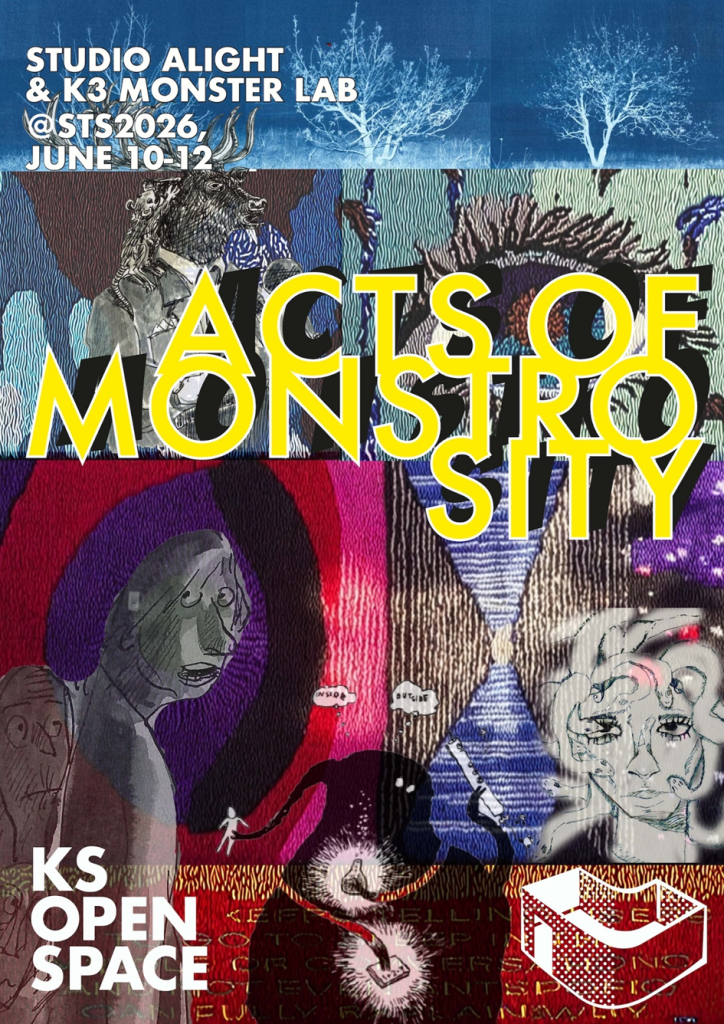
Wednesday 10 – Friday 12 June:
What:
Exhibition: Acts of Monstrosity
Who:
Åsa Harvard Maare, Samantha Hookway, Tracy Trägårdh, Fredrik Linander, Pille Pruulman-Vengerfeldt, Oskar Aspman.
Where and when:
KS Open Space during the entire conference.
Wednesday 10 June:
What:
Monster Drawing Workshop: A collaborative drawing experience focused on mapping out different monstrous typologies and ambiguous terrains.
The session begins with the group defining a theme together. This theme could be a problem, a specific place, a monstrosity, or a set of coincidences. Participants then create a series of drawings that chart pathways across the chosen area of exploration. The drawing process is split into two 20-minute intervals. After the first interval, there is a break for participants to view, explain, and rearrange their drawings. Following the second interval, participants work together to assemble the drawings into a cohesive whole.
The results of the workshop will be documented for methodological development. Participants are required to consent to being photographed and to have their drawings recorded.
10 participants.
Registration: sts2026@mau.se or at registration desk.
Who:
Åsa Harvard Maare, Pille Pruulmann Vengerfeldt, Oskar Aspman.
Where and when:
K3 open space, entry floor at 16:14 – 17:30.
Thursday 11 June:
What:
Panel: Living, thinking and working with monsters: Some different perspectives from the K3 Monster Lab
Monsters are creatures of cross-pollinations, contamination and (unholy) collaborations. Their hybrid bodies are created from the mingling of categories that – according to conventional
Western science and philosophy – are not meant to overlap, e.g. animal and human (the werewolf), dead and living (the vampire) and organic and mechanic (the cyborg). Whereas this undoing of conventions and agreed upon reality can make the monster horrifying, scholars and artists within norm critical fields have reclaimed and embraced this ability of the monster to undo status quo and show how things could be different. Such fields include feminist theory, queer theory, critical disability studies, decolonial and anti-racist studies as well as, of course, feminist STS. According to Donna Haraway, the monster is ‘promising’ (Haraway 1992), since it’s questioning of conventionally given categories and hierarchies makes space for different ways of becoming and living in the world with and as others. The promise of monsters (Haraway, 1992) does not, however, mean that monsters can be domesticated or even wielded for ‘good’, whatever that would be. What makes monsters monsters – apart from their hybridity – is that they cannot be pinned down, cannot be controlled (Cohen 1996). In her work on autonomous weapons systems, feminist STS scholar Lucy Suchman refers to ‘Frankenstein’s problem’ (Suchman, 2018), that is, the question of what sort of ethical responsibility one has for the unruly monsters one creates. Suchman draws parallels to present-day intelligent weapons systems, which are activated by the push of a button, after which whoever pushed the button can wash their hands of what the weapon does – like Frankenstein not taking responsibility for the horrors his monster commits after he abandons it. Suchman suggests that whatever monsters one creates, one needs to remain accountable for them (Suchman 2018).
With this panel, we explore these strands of ethics, creativity and norm-critical thinking relating to the monster. We present how each of us work with the monster both as a subject and as a creative and critical method rooted in contamination and cross-pollination. This all forms part of the (horrifying) collaborations we do together in the research group K3 Monster Lab at Malmö University.
Who:
Åsa Harvard Maare, Fredrik Linander, Tracy Trägårdh, Line Henriksen.
Where and when:
NI:B0308 at 11:15 – 12:30
Friday 12 June:
What:
Paper presentation: Monsters as methods for collaborating with external stakeholders to understand museum digitalization.
The paper examines several examples of how monsters can be employed as methods to foster research collaboration between museums and academia. The paper focuses on methodological contributions in the context of knowledge co-creation with museum professionals regarding complex techno-social relationships. The paper discusses monsters in visual, co-constructive, and collaborative workshop methods for studying museums’ data work, datafication, and museum digital and material infrastructures, and for exploring monstrous relationships between professionals and digital infrastructures. Drawing on examples from methodological innovation work involving online and offline workshops, drawing, collage, and adding text to a visual prompt, the paper argues that monsters can be productive in understanding complex socio- technical relationships as monsters have bodies with cultural content to which we can project our fears, anxieties and concerns. Monsters help outline the boundaries between the permissible and the forbidden and allow exploration of relationships between humans and others.
The paper argues that monster methods are, like monster pedagogy (Henriksen and Kvistad, 2017), always failing experiments, unpredictable, gappy and stitched together from disparate parts. That makes monster methods more like Haraway’s oddkins (2016), companions that don’t offer fool-proof solutions, but provide space to stay with trouble. As such, collaborative knowledge co-creation removes itself from the threat of becoming a solution-oriented consultancy and rather invites participants to explore the boundaries of what can be known and how to stay with the trouble.
Who:
Pille Pruulman-Vengerfeldt
Where and when:
NI:C0315 at 9:30 – 10:45